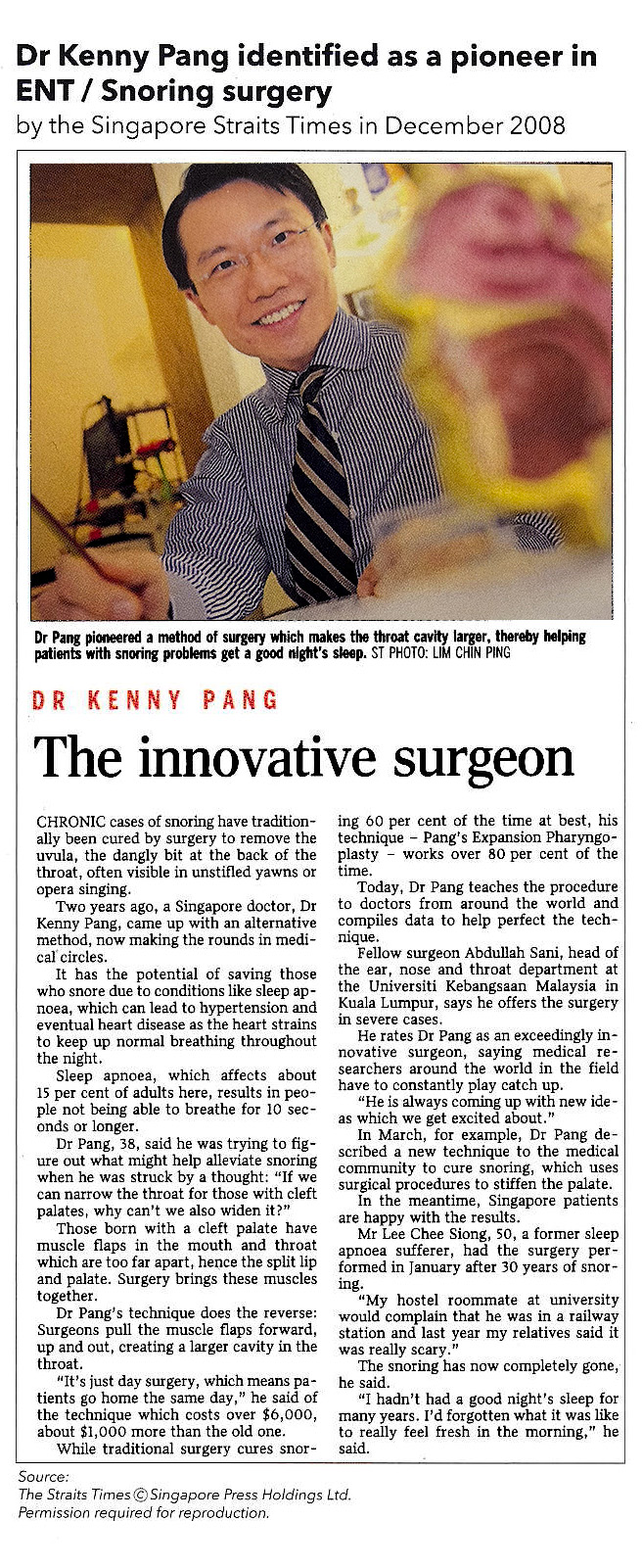
Photo caption: Dr. Pang pioneered a method of surgery which makes the throat cavity larger, thereby helping patients with snoring problems get a good night’s sleep. ST PHOTO: LIM CHIN PING.
CHRONIC cases of snoring have traditionally been cured by surgery to remove the uvula, the dangly bit at the back of the throat, often visible in unstifled yawns or rare singing.
Two years ago, a Singapore doctor, Dr Kenny Pang, came up with an alternative method, now making the rounds in medical circles.
It has the potential of saving those who snore due to conditions like sleep apnoea, which can lead to hypertension and eventual heart disease as the heart strains to keep up normal breathing throughout the night.
Sleep apnoea, which affects about 15 per cent of adults here, results in people not being able to breathe for 10 seconds or longer.
Dr Pang, 38, said he was trying to figure out what might help alleviate snoring when he was struck by a thought: “If we can narrow the throat of those with cleft palates, why can’t we also widen it?”
Those born with a cleft palate have a small flap in the mouth and throat which are too far apart, hence the split lip and palate. Surgery brings these muscles together.
Dr Pang’s technique does the reverse: Surgeons pull the muscle flaps forward, up and out, creating a larger cavity in the throat.
“It’s just day surgery, which means patients go home the same day,” he said of the technique which costs over $6,000, about $1,000 more than the old one.
While traditional surgery cures snoring 60 per cent of the time at best, his technique — Pang’s Expansion Pharyngoplasty — works over 80 per cent of the time. Today, Dr Pang teaches the procedure to doctors from around the world and helps refine and perfect the technique.
Fellow surgeon Abdullah Sani, head of the ear, nose and throat department at the Universiti Kebangsaan Malaysia in Kuala Lumpur, says he offers the surgery in severe cases. He rates Dr Pang as an exceedingly innovative surgeon, saying medical researchers around the world in the field have to constantly play catch up. “He is always coming up with new ideas which we get excited about.” In March, for example, Dr Pang described a new technique to the medical community to cure snoring, which uses surgical procedures to stiffen the palate.
In the meantime, Singapore patients are happy with the results.
Mr Lee Chee Sing, 50, a former sleep apnoea sufferer, had the surgery performed in January after 30 years of snoring.
“My hostel roommate at university would complain that he was in a railway station and last year my relatives said it was really scary.”
The snoring has now completely gone, he said.
“I hadn’t had a good night’s sleep for many years. I’d forgotten what it was like to really feel fresh in the morning,” he said.
Source:
- The Straits Times © Singapore Press Holdings Ltd.
- NLB archive, source: https://eresources.nlb.gov.sg/newspapers/digitised/issue/straitstimes20081227-1
Photo caption: Dr. Pang pioneered a method of surgery which makes the throat cavity larger, thereby helping patients with snoring problems get a good night’s sleep. ST PHOTO: LIM CHIN PING.
CHRONIC cases of snoring have traditionally been cured by surgery to remove the uvula, the dangly bit at the back of the throat, often visible in unstifled yawns or rare singing.
Two years ago, a Singapore doctor, Dr Kenny Pang, came up with an alternative method, now making the rounds in medical circles.
It has the potential of saving those who snore due to conditions like sleep apnoea, which can lead to hypertension and eventual heart disease as the heart strains to keep up normal breathing throughout the night.
Sleep apnoea, which affects about 15 per cent of adults here, results in people not being able to breathe for 10 seconds or longer.
Dr Pang, 38, said he was trying to figure out what might help alleviate snoring when he was struck by a thought: “If we can narrow the throat of those with cleft palates, why can’t we also widen it?”
Those born with a cleft palate have a small flap in the mouth and throat which are too far apart, hence the split lip and palate. Surgery brings these muscles together.
Dr Pang’s technique does the reverse: Surgeons pull the muscle flaps forward, up and out, creating a larger cavity in the throat.
“It’s just day surgery, which means patients go home the same day,” he said of the technique which costs over $6,000, about $1,000 more than the old one.
While traditional surgery cures snoring 60 per cent of the time at best, his technique — Pang’s Expansion Pharyngoplasty — works over 80 per cent of the time. Today, Dr Pang teaches the procedure to doctors from around the world and helps refine and perfect the technique.
Fellow surgeon Abdullah Sani, head of the ear, nose and throat department at the Universiti Kebangsaan Malaysia in Kuala Lumpur, says he offers the surgery in severe cases. He rates Dr Pang as an exceedingly innovative surgeon, saying medical researchers around the world in the field have to constantly play catch up. “He is always coming up with new ideas which we get excited about.” In March, for example, Dr Pang described a new technique to the medical community to cure snoring, which uses surgical procedures to stiffen the palate.
In the meantime, Singapore patients are happy with the results.
Mr Lee Chee Sing, 50, a former sleep apnoea sufferer, had the surgery performed in January after 30 years of snoring.
“My hostel roommate at university would complain that he was in a railway station and last year my relatives said it was really scary.”
The snoring has now completely gone, he said.
“I hadn’t had a good night’s sleep for many years. I’d forgotten what it was like to really feel fresh in the morning,” he said.
Source:
- The Straits Times © Singapore Press Holdings Ltd.
- NLB archive, source: https://eresources.nlb.gov.sg/newspapers/digitised/issue/straitstimes20081227-1